
Rollstock Film Buyer’s Guide: Unwind Direction (#1–#8), Core Size, Eye Marks & VFFS/HFFS Specs
Ordering pre-made pouches is straightforward—you confirm width, height, and zipper style. Ordering custom printed rollstock film for an automated filling line is different. One wrong unwind number, an oversized roll outer diameter, or a noisy eye-mark track can stop a co-packer’s vertical form-fill-seal (VFFS) or horizontal flow-wrap (HFFS) machine on day one.
This factory-level engineering guide walks brand owners and operations teams through every specification on a co-packer’s rollstock spec sheet—from VFFS vs. HFFS film structures and unwind directions (#1–#8) to 3-inch core tolerances, photocell eye-mark rules, and coefficient of friction (COF) tuning.
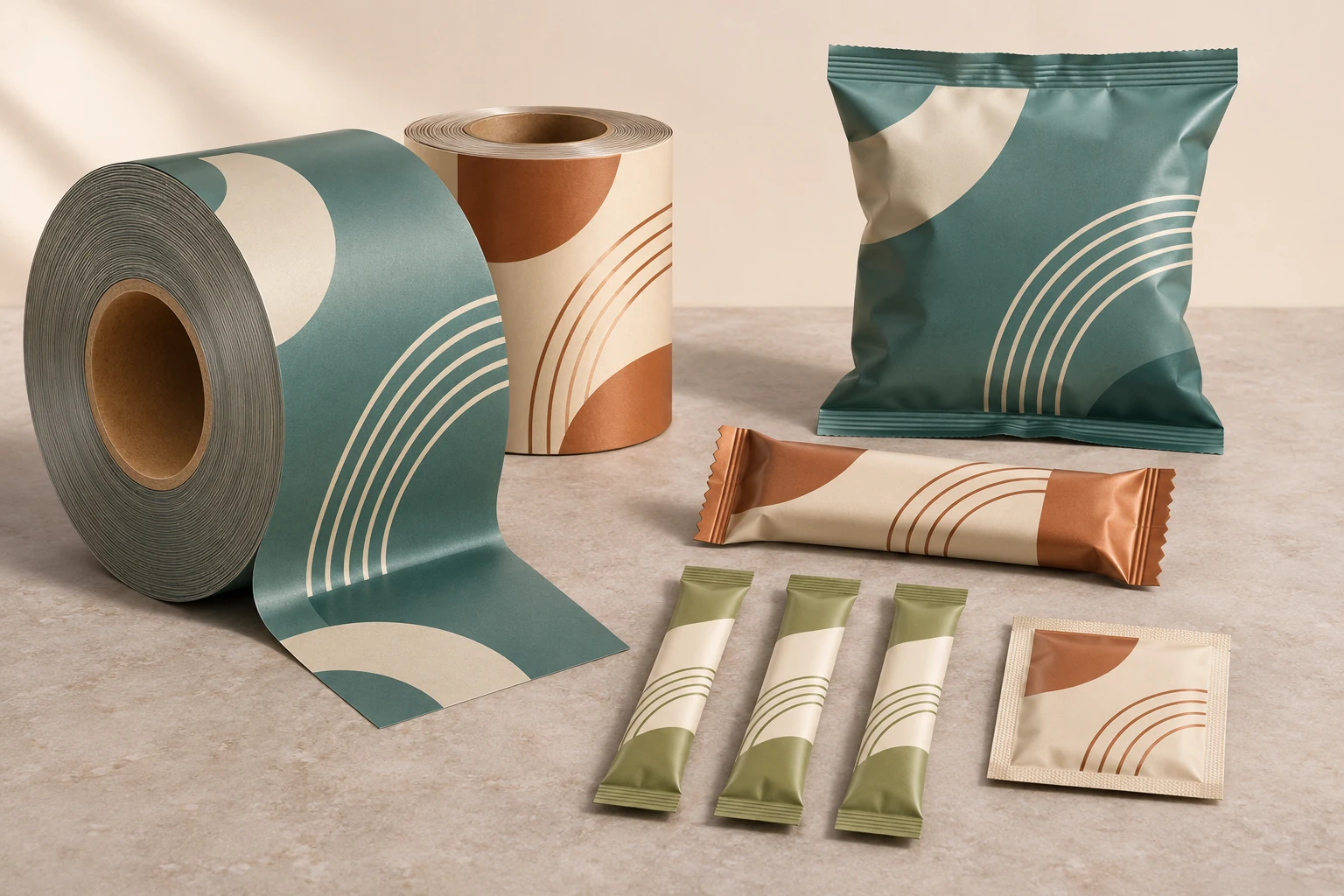
VFFS vs. HFFS vs. Stick-Pack Rollstock: Matching Your Machine
Before selecting a laminate thickness or barrier film, confirm how your packaging line forms, fills, and seals the web. Each machine architecture places different mechanical demands on the film:
| Machine Type | Finished Pack Formats | Key Film Requirements | Typical Products |
|---|---|---|---|
| VFFS (Vertical Form-Fill-Seal) | Pillow bags, gusseted bags, flat-bottom packs | Controlled outer COF for forming collar glide; fast hot-tack inner sealant to hold vertical product drops | Chips, nuts, granola, coffee beans, frozen foods, dry mixes |
| HFFS (Horizontal Flow Wrap) | Fin-seal flow wraps, tray overwraps | High tensile stiffness, crisp longitudinal fin sealing, optional cold-seal coating for heat-sensitive items | Protein bars, cookies, chocolate, baked goods, soaps |
| Stick-Pack & Multi-Lane Sachet | Tubular stick packs, 3-side or 4-side seal sachets | Precision narrow-web slitting, dead-fold/tear consistency, high-barrier foil (PET/AL/PE) to stop powder clumping | Electrolytes, instant coffee, collagen, liquid gels, condiments |
Not ready to invest in automated machinery or co-packer line minimums yet? You can launch first with pre-made stand-up pouches, center-seal stick packs, or custom gusseted bags starting from 100 pcs.
Understanding Rollstock Unwind Direction (#1–#8)
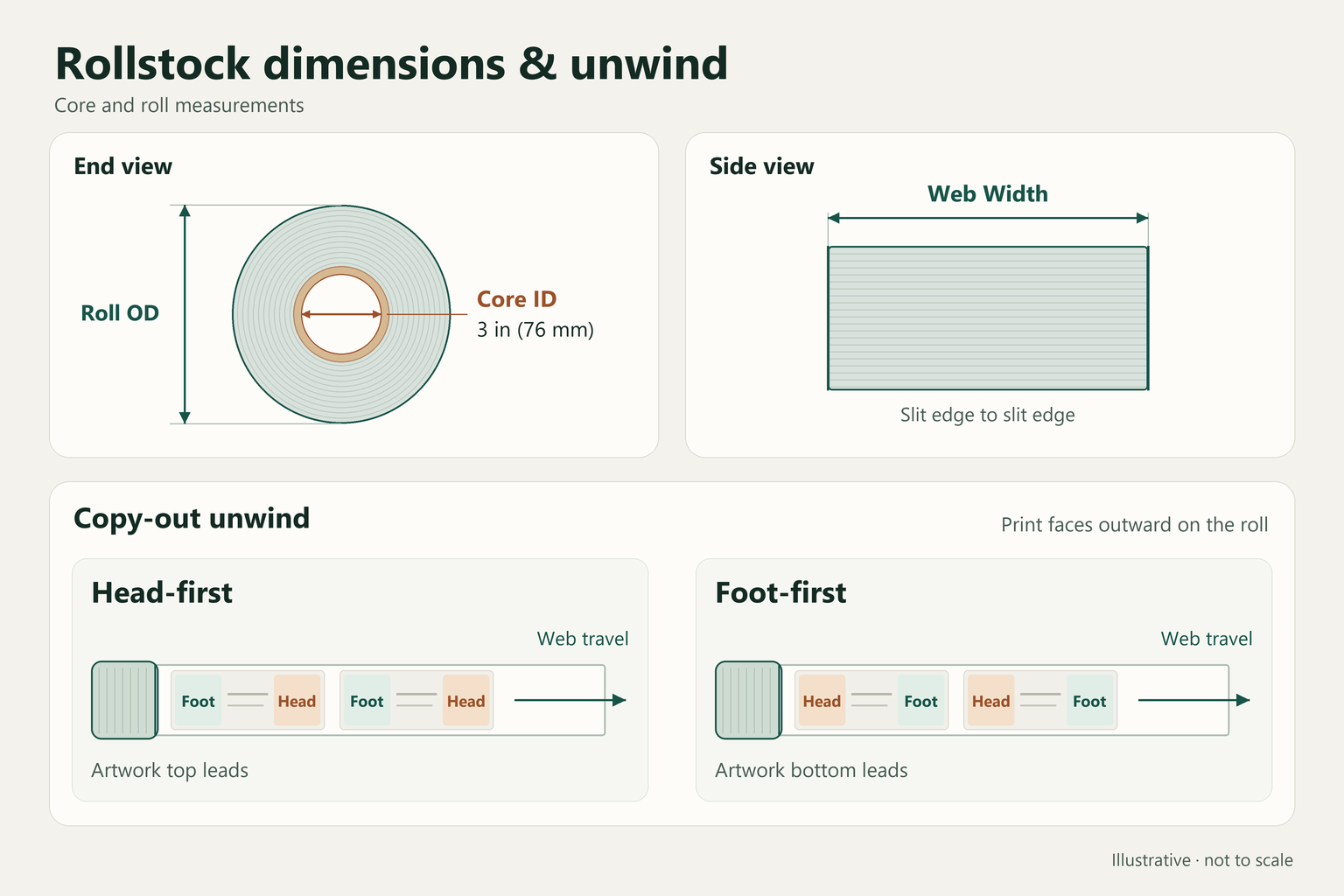
The single most common mistake in first-time rollstock orders is specifying the wrong unwind direction. An unwind chart records two things: whether the printed side faces outward (Copy Out) or inward (Copy In), and which edge of your artwork feeds off the roll first into the machine (top/head, bottom/foot, right, or left).
| Example Unwind Code | Print Side | Artwork Feed Orientation | Common Machine Use |
|---|---|---|---|
| #1 / #2 | Copy Out (Outside Wound) | #1 Top / Head First · #2 Bottom / Foot First | Most standard VFFS pillow/gusset lines and vertical stick-pack machines |
| #3 / #4 | Copy Out (Outside Wound) | #3 Right Edge First · #4 Left Edge First | Most horizontal HFFS flow wrappers (bars, cookies, horizontal sachets) |
| #5 – #8 | Copy In (Inside Wound) | #5 Top · #6 Bottom · #7 Right · #8 Left First | Specialty unwind stands or reverse-feed web paths |
Factory Tip: This table shows one common numbering convention. Use your co-packer’s official unwind diagram and match the leading artwork edge and print-side orientation to the proof. Suppliers can number the same orientation differently.
Core ID, Max Roll OD, Web Width & Repeat Length (Pitch)
Your converter slits master laminated reels down to the exact mechanical dimensions your machine mandrel and dancer rollers can accept:
- Core Inner Diameter (Core ID): 3 inches (76 mm) is a common core ID. Some wide-web lines use 6 inches (152 mm). Confirm the ID and tolerance against the actual mandrel.
- Maximum Roll Outer Diameter (Max OD) & Roll Weight: Confirm maximum roll OD and weight, available clearance, and the limits of the co-packer’s roll-handling equipment.
- Web Width (Film Width): For a VFFS pillow bag, web width generally equals
(2 × Finished Bag Width) + Fin-Seal Overlap(use the seal allowance from your machine’s approved dieline). - Repeat Length (Cut-Off / Pitch): The machine-direction distance between equivalent eye marks on successive print repeats. Set it using the cut-off pitch and approved dieline, including the seal margins.
Photocell Eye Marks & Sensor Track Rules
Automated wrappers do not read your logo to know where to cut—they rely on an optical sensor detecting a high-contrast printed rectangle called an eye mark (or registration mark).
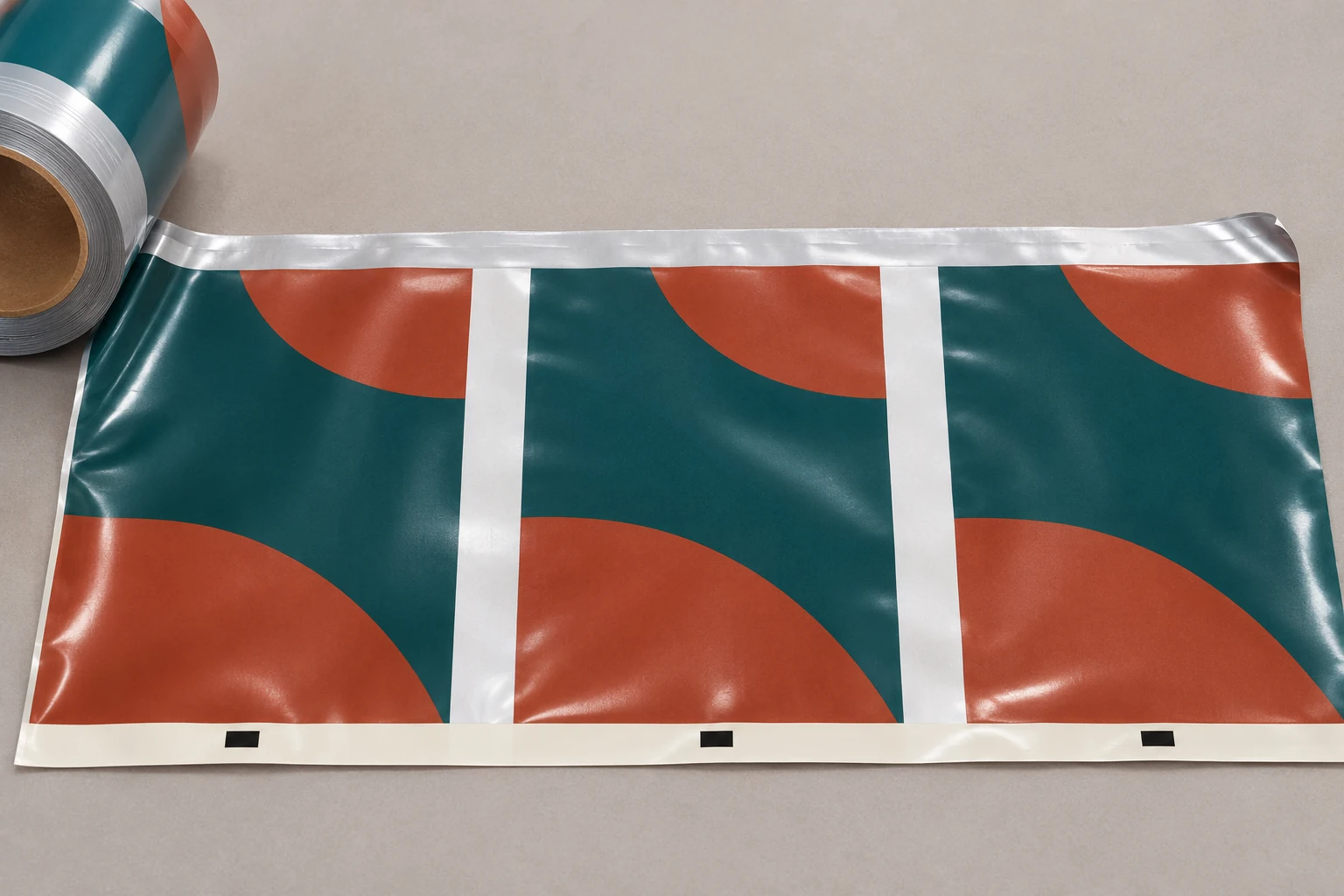
- Standard Eye-Mark Size: Typically 10–15 mm wide × 4–8 mm tall (confirm exact dimensions with your machine manual).
- High Contrast Against Background: Dark black or deep dark-green marks against a white or light background read most reliably. Avoid metallic glare directly on the mark.
- Keep the Sensor Track Clear: The entire vertical lane in line with the eye mark must remain free of barcodes, logos, or dark text; other graphics in the track can cause false triggers and misaligned cuts.
Barrier Laminates, COF & Heat-Seal Engineering
Two rollstock films with identical thickness can run completely differently on the same VFFS machine if their Coefficient of Friction (COF) and sealant resin are mismatched:
- COF (Slip Control): Film must glide smoothly over the stainless-steel forming shoulder (typically targeting a low-to-medium outer kinetic COF around 0.20–0.30, verified per machine) without slipping on rubber pull belts.
- Hot-Tack Sealant Layer: On vertical VFFS lines, the bottom horizontal seal has to support the weight of falling nuts, coffee, or powder milliseconds after the jaws open. LLDPE, metallocene PE (mPE), and VMCPP are options for tuning hot tack. Verify seal strength under actual line dwell time and fill load.
- Barrier Film Selection: Choose BOPP/VMCPP or PET/VMPET/PE for crisp snacks and bars, PET/AL/PE true aluminum foil for moisture-sensitive powders and stick packs, or MDO-PE / PE-EVOH-PE for mono-material designs intended for PE recycling where accepted (confirm the final structure, local collection rules, and line heat-seal performance). Compare OTR/WVTR benchmarks in our barrier film structure guide, recyclable vs. compostable film guide, or all material & barrier options.
Note: Final COF targets, heat-seal jaw temperatures, and shelf-life performance should always be validated on your specific filling machine and product.
Digital Short-Run Rolls vs. High-Volume Rotogravure
Conventional rotogravure rollstock can require a higher minimum run per SKU and a separate charge for engraved cylinders. With in-house HP Indigo 200K digital printing, brands can now order short-run digital rollstock with $0 cylinder fees—ideal for co-packer line trials, multi-flavor bar lines, and seasonal packaging—with production in as fast as 5 business days for eligible orders after artwork proof, unwind chart, and specification approval (transit separate).
Once a hero SKU scales into continuous high-speed production, we seamlessly transfer your approved artwork and mechanical specs to rotogravure printing (up to 10 colors, registered matte varnish, and specialty cold-seal options) to lower your cost per thousand impressions. Before submitting files, check our flexible packaging artwork preparation guide to ensure seal zones and eye-mark lanes are set up cleanly.
Frequently Asked Questions About Rollstock Film
What information do I need from my co-packer before ordering rollstock film?
Request six core items from your co-packer: machine type (VFFS, HFFS, or stick pack), web width, repeat length (cut-off pitch), core inner diameter (commonly 3 in / 76 mm, subject to machine fit), maximum roll outer diameter (OD) or roll weight limit, and their visual unwind direction diagram plus eye-mark dimensions.
How do I calculate how many linear meters of rollstock film I need?
For a single-lane line producing one pack per repeat, multiply the pack count by the repeat length in meters. For example, 10,000 packs at a 0.20 m pitch require 2,000 net meters. With a 10%–15% allowance, that is 2,200–2,300 gross meters. Confirm the waste allowance and any multi-lane yield with your co-packer using actual machine and product trial data.
What is the difference between Copy Out (#1–#4) and Copy In (#5–#8) unwind?
Copy Out means the printed face is wound outward, and Copy In means it faces inward toward the core. The example chart uses #1–#4 for Copy Out and #5–#8 for Copy In. Use your co-packer’s diagram to confirm the leading artwork edge and print orientation.
Can I run recyclable Mono-PE rollstock on a standard VFFS or HFFS machine?
Yes, MDO-PE / PE-EVOH-PE recyclable rollstock can run on compatible VFFS and HFFS lines. The heat-seal window depends on the exact PE structure and machine setup. We recommend running a short trial roll first to fine-tune jaw temperature, pressure, and dwell time.
What is the minimum order quantity and lead time for custom printed rollstock?
Our HP Indigo 200K digital press supports low-MOQ short-run rollstock orders (quoted by linear meters and roll specs) with zero plate or cylinder fees, finishing production in as fast as 5 business days on eligible orders after artwork proof, unwind direction, and specifications are approved. Transit is separate. High-volume SKUs can scale directly into rotogravure supply.
Ready to Spec Your Custom Rollstock Film?
Already have a co-packer spec sheet—or need help calculating web width, pitch, and barrier structure from your target pack size? Send our engineers your product details and machine type for a factory-direct quote and free film swatches.
Explore Custom Rollstock Film Specs → | Request a Rollstock Quote ↗