
Recyclable vs. Compostable Stand-Up Pouches: Which Fits Your Brand?
As global brands and consumers push for environmental accountability, the demand for sustainable packaging has skyrocketed. For B2B buyers, navigating this shift often comes down to one pivotal choice: recyclable vs. compostable stand-up pouches. Both formats provide an eco-friendly alternative to traditional multi-layer, non-recyclable foil laminates, but they differ fundamentally in materials, performance, waste streams, and cost.
Choosing the wrong sustainable structure can lead to degraded shelf life, burst seals during transit, or unintentional greenwashing. In this comprehensive B2B buying guide, our engineering team at Zhongfeng Packaging breaks down the science, costs, and practical realities to help you select the exact sustainable pouch for your product.
At a Glance: Recyclable vs. Compostable Pouches
Before diving into materials and barrier properties, let’s compare how these two eco-friendly stand-up pouches perform across key commercial metrics:
| Feature | Recyclable Stand-Up Pouches | Compostable Stand-Up Pouches |
|---|---|---|
| End-of-Life Waste Stream | Recycling Bin: Eligible for Store Drop-off or #4 LDPE streams | Compost Bin: Industrial composting facility (compostable PLA/kraft) or home bin (compostable home-friendly) |
| Core Base Materials | Mono-Material: Single-source Polyethylene (MDO-PE + PE with EVOH-PE barrier) | Bio-based Materials: Natural kraft paper, PLA (Polylactic Acid from cornstarch), PBS, or cellulose |
| Barrier Capabilities (OTR/WVTR) | High-to-Excellent: EVOH-PE barrier layers protect against oxygen and moisture effectively | Moderate-to-Good: Higher moisture/oxygen transmission; bio-films naturally have higher permeability |
| Estimated Product Shelf Life | 6 to 12+ months (best for powders, snacks, and medium-term storage) | 3 to 6 months (best for fast-moving local retail or low-humidity goods) |
| Material Cost | Moderate: Roughly 15% to 30% higher than traditional foil, but scalable | High: Typically 40% to 70%+ higher than traditional multi-layer plastic due to specialized raw bio-resins |
| Standard certifications | How2Recycle, CE #4, OPRL (UK) | BPI (US), TUV AUSTRIA (OK compost INDUSTRIAL / HOME), EN 13432 |
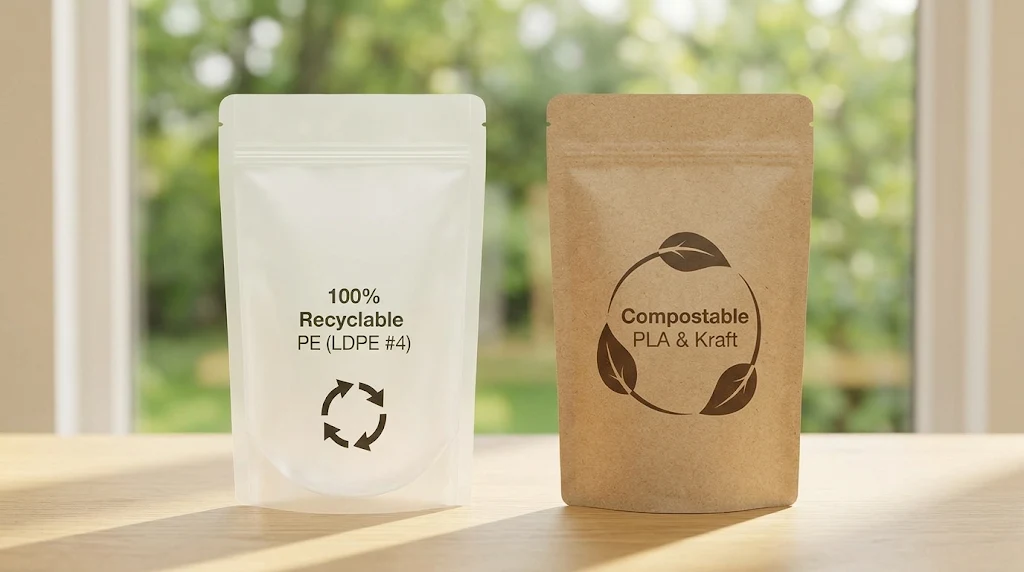
Understanding Recyclable Stand-Up Pouches (Mono-PE)
The main challenge of recycling traditional custom stand-up pouches is their multi-layer structure (such as PET/AL/PE), which bonds different materials together permanently. Recyclable stand-up pouches solve this by using mono-material structures—typically 100% Polyethylene (PE) or Polypropylene (PP).
How Mono-PE Provides High Barrier
Because B2B brands cannot sacrifice shelf life, we laminate Machine Direction Oriented Polyethylene (MDO-PE) on the outer print layer for stiffness and heat resistance, paired with low-density Polyethylene (LDPE) on the inside for heat sealing. To prevent oxidation, we integrate a thin EVOH-PE co-extruded barrier. Because EVOH makes up less than 5% of the pouch’s total weight, the bag remains fully recyclable within existing #4 LDPE recycling streams (including “Store Drop-off” in North America).
Recommended Applications
Mono-material PE is highly recommended for snacks, pet treats, wellness powders, and dry foods that require an active barrier against moisture and oxygen but still need to meet “recyclable” brand claims.
Understanding Compostable Stand-Up Pouches (PLA & Bio-Films)
Instead of being kept in the circular economy through recycling, compostable pouches are engineered to biodegrade into natural, non-toxic organic material under specific temperature and moisture conditions.
The Complex Multi-Layer Bio-Structure
To keep the packaging sturdy and functional, compostable stand-up pouches use bio-based laminations, often combining natural kraft paper (for a rustic, organic look and stiffness) with PLA (Polylactic Acid), PBS (Polybutylene Succinate), or cellulose-based barrier films. These materials are derived from renewable resources like cornstarch or wood pulp.
The Real-World Disposal Catch
B2B buyers should note the difference between industrial compostable and home compostable:
- Industrial (Commercial) Compostable: Requires high heat (above 55°C/130°F), humidity, and specific microbes in commercial facilities (certified under ASTM D6400 / EN 13432) to break down. Most consumers do not have access to these curbside collections.
- Home Compostable: Breaks down in ambient backyard compost piles over 6 to 12 months, but usually provides much lower barrier protection and requires thicker, more expensive specialty film structures.
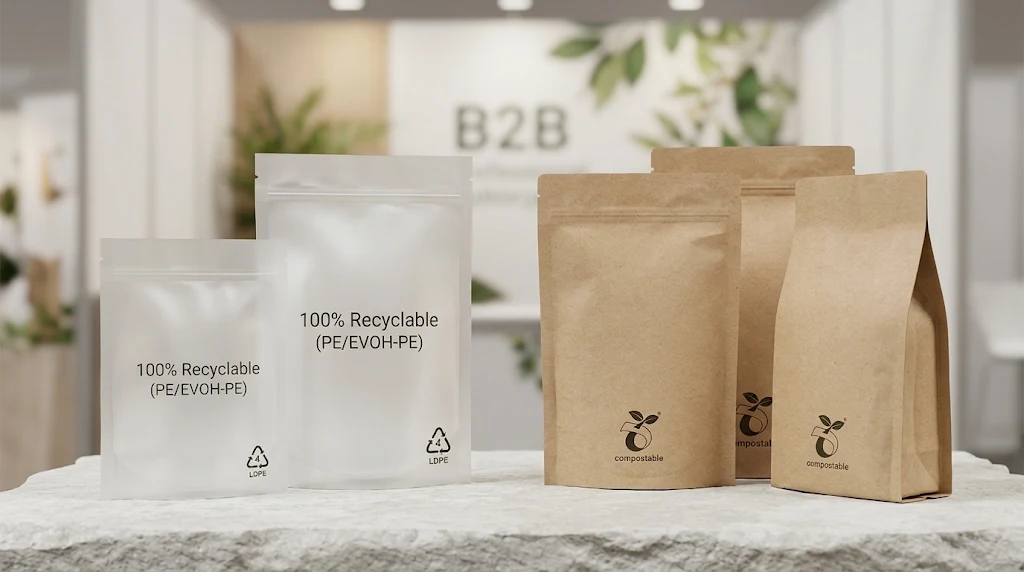
Cost, Barrier, and Supply Chain Realities
When specifying custom pouches from Zhongfeng Packaging, we work with you to analyze how these sustainable options impact your final production budget and fill operations:
The Barrier and Shelf-Life Factor
Natural kraft paper and PLA compostable film structures are more permeable to water vapor and oxygen. For freshly roasted custom coffee bags and tea packaging, compostable structures generally hold their freshness for 3 to 6 months compared to the 12+ months achieved with aluminum foil or recyclable Mono-PE with EVOH. Nylon (PA) layers, commonly used to prevent drop-test punctures in heavy 5 lb wholesale side gusset bags, also have to be replaced with specialized high-cost bio-alternatives on compostable orders.
Production and Seal Quality
Compostable and recyclable films have narrower heat-sealing window ranges on automatic fill-and-seal packaging machinery. Our team of engineers will confirm your material’s exact thickness (typically 120 µm to 140 µm) and sealing requirements, and can supply free unprinted material sample packs so you can test them firsthand on your own equipment.
Digital Printing Flexibility (Low 100-pc MOQ)
Using HP Indigo 200K digital printing, we can manufacture custom-printed recyclable and compostable stand-up pouches starting from 100 pieces per design and specification, with zero plate fees and digital proofs included. As your volume scales into the tens of thousands, we can transition your artwork to gravure printing to keep your sustainable unit cost as competitive as possible.
Frequently Asked Questions (FAQ)
Can recyclable and compostable pouches be used interchangeably on standard filling machines?
Not always. Compostable and recyclable films do not dissipate heat the same way as traditional PET/AL/PE multi-layers, and may require lower heat-sealing temperatures and longer dwell times. We recommend running machine test trials using existing factory sample bags, which we can provide for free (shipping cost paid by the customer), before launching a full custom production run.
Do recyclable pouches offer the same barrier protection as traditional foil bags?
High-barrier mono-material PE with laminated EVOH-PE barrier films comes extremely close, effectively blocking oxygen and moisture to achieve a 6-to-12+ month shelf life. While it may not fully reach the near-zero transmission rates of pure aluminum foil, it is typically superior to bio-based compostable films.
What is the minimum order quantity for sustainable custom printed pouches?
Our standard digitally printed recyclable and compostable pouches start at 100 pieces per design, size, material, and finish with zero plate fees. Free complete packaging design and digital proofs are included.
How do certifications (like BPI or TUV) apply to custom orders?
Zhongfeng Packaging utilizes certified biodegradable/compostable raw resins and recyclable PE films. On custom-printed pouches, we can include the appropriate recycling or industrial compost logos with your artwork once our engineers confirm your specific material layers and use cases meet official ASTM D6400 or EN 13432 guidelines.
Compare Sustainable Options for Your Brand
Choosing between recyclable and compostable packaging depends on your shelf-life requirements, unit budget, and target waste stream. Our Guangzhou factory team is here to walk you through film options, barrier levels, and delivery times before preparing a formal quotation.